
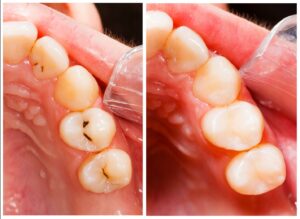
For more than a hundred years, amalgam fillings have been a go-to for dentists when it comes to restoring cavities. But these days, the experts are turning towards tooth-colored fillings made of composite resin to fill in the holes caused by tooth decay. Why have they changed their tune? Just keep reading to learn a few reasons tooth-colored fillings are more advantageous to patients than an amalgam alternative.
1. Tooth-Colored Fillings Are Much Less Noticeable
If you’re of a certain age, there’s a good chance you remember seeing that distinct silver color flash every now and then when someone smiled or spoke. You may have even had a few yourself! Amalgam fillings are made of a mixture of metals that don’t exactly lend themselves to a discreet appearance.
Tooth-colored fillings, however, can be shaded so that they match the color of your surrounding teeth. This is due to the malleability of composite resin. Patients love that if they must have a cavity treated, they’re not broadcasting it to the world every time they open their mouth!
2. Patient-Friendly Material
Roughly half of an amalgam filling is composed of liquid mercury. While the FDA and the American Dental Association maintain that existing amalgam fillings do not pose serious health risks for healthy adults, mercury and other metals found in amalgam fillings, like silver, tin, and copper, may be of concern to patients with specific health conditions or sensitivities.
If this pertains to you, be sure you raise your concerns with your dentist. You may be just the right candidate for a tooth-colored alternative.
3. Tooth Sensitivity
The metals found in amalgam fillings are much more affected by extreme temperatures, whether hot or cold. You may find that your morning cup of coffee or a frozen treat like a popsicle can cause uncomfortable sensitivity in your mouth.
Composite resin is much less sensitive to temperature changes. Not only does that mean you can confidently enjoy your favorite hot and cold foods and drinks, but tooth-colored fillings are also less susceptible to cracks that can occur in amalgam from exposure to extreme temperatures.
4. Save More of Your Natural Tooth
When preparing to treat a cavity with an amalgam filling, dentists typically must remove more of the natural tooth structure to make space for the material. On the other hand, composite resin bonds directly to the remainder of your natural tooth as it dries, meaning less drilling is required to secure it in place.
A key component of restorative dentistry is to preserve as much of your natural tooth structure as possible. Tooth-colored fillings allow your dentist to do so.
5. Versatility
In some cases, restoring your tooth means more than just filling a cavity. Tooth decay may have advanced to the point that there isn’t enough healthy structure left to support a filling. In such an instance, your dentist may recommend a dental crown, which can be fashioned from composite resin.
This versatile bonding material can also be used to fix small tooth fractures, reshape uneven teeth, and make other minor cosmetic repairs.
If your latest dental checkup has revealed a cavity in your smile, ask your dentist about tooth-colored fillings. This modern solution to tooth decay can keep you smiling with confidence!
About the Author
If you’d love to chat college football while receiving the best dental care available in Conyers, GA, Dr. Kimberly Peters is the professional you’ve been looking for. She was educated at the Medical College of Georgia and has more than 10 years of experience practicing dentistry. For more information on restorative services and other treatments Dr. Peters and her team provide, visit Hillcrest Dentistry online or call (770) 922-1666.